Credit is power. Borrowed power yes, but it is still power. Just think about this - every credit card you're carrying now has a balance that's 3X to 4X your monthly income! Well… unless you're carrying this baby, which comes with no pre-set spending limit.
Of course, if you abuse the spending power that credit cards give you - you're going to be in a world of financial pain. And if there's one kind of debt you should avoid at all cost, it's credit card debt!
For some people, getting a credit card in the first place was their biggest credit card mistake. But you're not going to be in that category - because you're going to read this article about the 3 credit card mistakes you should avoid (because you know you don't want a lifetime of credit card debt):
1. Thinking that credit is "your" money
Whenever you reach into your wallet or purse to pay for something, what do you reach for first to pay for it? Is it your credit card? Is it always your credit card?
Yes, there are times when using a credit card is smart such as getting discounts or earning points for your rewards programmes. But if you're using your credit card all of the time instead of cash or your debit card - that's a huge mistake that can set you on the path to racking up some serious credit card debt.
Before you reach for your wallet or purse next time, think about this - your cash = your money, your debit card = your money and your credit cards = NOT your money.
Not only is it NOT your money, but it comes with a pretty high interest rate as well - 24 per cent+, which will make rollover balances grow faster than . So before you reach for your credit card first to buy something, think about whether you have enough to buy it with YOUR money first!
2. Financing extremely big purchases with credit
It's pretty easy to spend "somebody else's money" right? All you have to do is swipe and go. Seriously, you can just walk into any store, purchase hundreds of dollars' worth of merchandise and go in a matter of minutes.
The sad thing is that you can do the same with BIG purchases just as easily. But what people fail to realise is that carrying a huge credit card balance at 24 per cent+ is like walking around with financial ball-and-chain around your ankle for a few years.
Here are some big purchases you should absolutely avoid putting on your credit card(s):
An expensive holiday: Yes, you probably deserve a holiday for your hard work. But you should never pay for your whole holiday on credit.
Once you see the bill and how long it'll take you to pay it off upon on your return, you'll probably have to skip holidays for a few years. Besides, if you want to borrow some money for a holiday, you're better off taking a personal loan instead.
Tuition fees (higher education): Whether you're paying for your child's tuition fees or your own, the last thing you want is to put a huge balance on your card that'll take years to pay back! If you want to borrow, it's cheaper just to take out an education loan.
Major down payments: Your desire to get behind the seat of a new car could leave you with a bill that you'll end up paying well after your car has been scrapped. If you're resorting to credit to make a down payment, you're probably not ready for the purchase anyway.
The same goes for medical bills, your wedding, or any other big purchase over $5,000. You wouldn't take out a loan on a BIG purchase if you had to pay a 24 per cent+ interest rate right? Unless you are ready to repay the expenditure reasonably soon, that compounding interest is going to kill you.
3. Having a high credit utilisation ratio
If you make credit mistakes #1 and #2 - you're bound to end up with a high credit utilisation ratio. What is your credit utilisation ratio? Simple, it's the ratio of your credit card balance(s) to your credit card limit(s).
For example:
If your credit card has a credit limit of $20,000 and you use $15,000 of it to purchase 3,000 copies of Sun Ho's album "China Wine", your credit utilisation ratio would be 75 per cent ($15,000 credit card balance / $20,000 credit card limit).
This is important because the higher your credit utilisation ratio is, the more you'll scare the credit bureau into lowering your credit rating. And when the credit bureau gets scared, lenders get scared. And when lenders get scared, you end up with higher interest rates on loans.
The only way to get your credit score back up is to reduce your balance(s) to a reasonable credit utilisation ratio (at least below 30 per cent).
- See more at: http://business.asiaone.com/personal-finance/credits-and-loans/3-credit-card-mistakes-you-should-avoid#sthash.22OCEl4v.dpuf
2015年6月15日星期一

2012年9月12日星期三
ceco
4. Career Education Corporation's (CECO)
family of colleges, schools and universities offer high-quality
education to a diverse student population of more than 75,000 students
across the world in a variety of career-oriented disciplines through
online, on-ground and hybrid learning program offerings. The more than
90 campuses that serve these students are located throughout the United
States and in France, the United Kingdom and Monaco, and offer doctoral,
master's, bachelor's and associate degrees and diploma and certificate
programs.
(click to enlarge)
Financials
The company reported the second-quarter financial results on July 31 with the following highlights:
Outlook
Mike Graham - EVP and CFO commented during the second quarter earnings conference call:
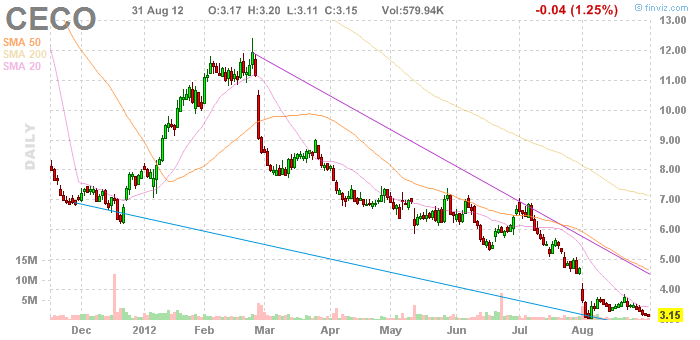
The stock is currently trading at 44% discount to its net cash per share value. I am not expecting the company to be profitable for the full-year 2012. I believe the company could be profitable again in 2013 based on the company's past performance. I would be looking to be a buyer around $3 level.
(click to enlarge)
Financials
The company reported the second-quarter financial results on July 31 with the following highlights:
| Revenue | $369.0 million |
| Net loss | $100.2 million |
| Cash | $369.9 million |
| Debt | $0 |
| Net Cash | $369.9 million |
| Shares outstanding | 66.0 million |
| Net cash per share | $5.60 |
Mike Graham - EVP and CFO commented during the second quarter earnings conference call:
Turning to an outlook, as you know as a matter of policy, we do not provide annual guidance. As you can see from the difficult marketing conditions we've faced, evidenced by our level of new student starts, and the commentary of many other comparable for-profit education firms in the last 10 days, inflection points we have assumed continue to move back causing our anticipated 2012 results, as Steve said, excluding the non-cash impairment charges, now to move into an operating loss level.My analysis
While visibility if the inflection point remains unclear, we do not right now anticipate a material improvement in our trend of new student starts as compared to the prior year adjusted for the timing of calendar changes in the third quarter of 2012. Our financial results versus our previously communicated range of 2012 ground school operating losses will also be impacted by the lower level of new student starts. Accordingly, our expectations for the ground schools versus last quarter's earnings release and conference call have fallen as well. Given the current market conditions, we will not provide any further milestones at this time.
Before we open the call for questions, let me quickly update you on the financial position as of June 30, 2012, the company had cash, cash equivalents, and short-term investments of $370 million. Our cash flow for operations for the three months ended June 30, 2012, was approximately a $1 million cash outflow. And capital expenditures were $8 million or 2.1% of revenues.
The stock is currently trading at 44% discount to its net cash per share value. I am not expecting the company to be profitable for the full-year 2012. I believe the company could be profitable again in 2013 based on the company's past performance. I would be looking to be a buyer around $3 level.
2010年5月11日星期二
One Bet You're Sure to Lose
One Bet You're Sure to Lose
By Austin Edwards
May 11, 2010 | Comments (1)
Four minutes from now, you and I are going to make a bet -- and I can virtually guarantee you will lose.
But first, I'm going to tell you something that may shock you; explain how it can lead you to the top 10 performing stocks of the upcoming year; and give you the names of three stocks that our analysts are convinced will trounce the market over the coming year and beyond.
Up to the challenge?
Good. Let's start with a little warmup exercise I do with anyone who asks me for a hot stock tip. Take the next minute or so to jot down a few stocks you think are among the 10 top-performing stocks of the past 365 days.
Lately, folks have been listing hot tech names like Apple. Granted, it has at least doubled over the past year, but it isn't even among the 10 top-performing large caps ...
Large-Cap Stock (;$10B) Market Cap 52-Week Gain
Mechel $10.2 billion 171%
Baidu $22.2 billion 161%
Fifth Third Bancorp $11.4 billion 158%
Teck Resources $22.3 billion 148%
priceline.com $11.2 billion 126%
Intuitive Surgical $13.5 billion 114%
Las Vegas Sands $15.4 billion 111%
VMware $24.9 billion 105%
Ctrip.com $10.1 billion 101%
Cummins $14.5 billion 98%
Source: Google Finance as of May 10.
Now, let's have a look at the top 10 performers overall ...
Stock Market Cap 52-Week Gain
Keryx Biopharmaceuticals $329 million 1,951%
General Growth Properties $4.7 billion 1,668%
inTEST Corporation $36 million 1,540%
Somaxon Pharmaceuticals $160 million 1,316%
Magnum Hunter Resources $292 million 1,070%
Jazz Pharmaceuticals $280 million 1,041%
Human Genome Sciences $4.7 billion 1,041%
Select Comfort $541 million 922%
Radio One $248 million 876%
Spanish Broadcasting System $114 million 859%
Source: Google Finance as of May 10.
Shocked?
Most people are. For the most part, these are companies most investors have never even heard of -- let alone seen on CNBC or read about in Fortune, Money, or Forbes.
Now, you might think this is some sort of anomaly caused by last year's financial near-collapse, but it actually holds true year after year after year after year.
As Motley Fool co-founder Tom Gardner points out, the next home run stock will almost always be:
1. Small (market cap of less than $2 billion)
2. Obscure
3. Ignored
In fact, Tom launched our Motley Fool Hidden Gems small-cap stock service with one goal in mind: to uncover well-managed, fast-growing, cash-generating businesses that are simply too small or too obscure for Wall Street analysts to cover.
Two Hidden Gems we're betting on now
Back in March 2009, Tom handed $250,000 to his two top small-cap analysts and tasked them with building a real-money, best-of-the-best small-cap portfolio.
Of the stocks Seth Jayson and Andy Cross have purchased so far, Dynamic Materials (Nasdaq: BOOM), Prestige Brands (NYSE: PBH), and AZZ (NYSE: AZZ) have particularly caught my eye.
Dynamic Materials is a dominant player in the highly specialized explosive metalworking industry. In fact, it's the biggest company of its kind in both North America and Europe -- and because this is a very hard industry to break into, it's highly unlikely that major competitors will spring up any time soon.
Meanwhile, Prestige Brands has a stable of relatively recession-resistant health-related brands (including Compound W, Comet, Clear Eyes, and Chloraseptic) and a focused strategy, makes a lot of cash, and as our Hidden Gems team puts it, “possesses some delightful hidden assets.”
And AZZ primarily designs and manufactures specialized parts and equipment for utilities and industrial companies -- things like bus ducts, power distribution enclosures, relay panels, switch gear, and substation services.
You can bet this division will thrive as the U.S. government begins investing billions -- possibly even trillions -- into rebuilding our power grid. Yet, thanks to the recent downturn in infrastructure spending, AZZ is selling well below what our analysts consider fair value.
Couple that with AZZ's healthy balance sheet (lots of cash, with $100 million in senior notes not payable until 2018) and solid 2.7% dividend, and you'll begin to see why our Hidden Gems team recently opened a small position.
Granted, these three companies are already up 47%, 13%, and 33%, respectively, since the Hidden Gems team purchased shares. But they're all well-positioned to rocket even higher once the economic recovery kicks into full gear.
The big payoff for you
While large-cap companies with strong brands, wide consumer appeal, and aggressive marketing campaigns like Las Vegas Sands (NYSE: LVS) and priceline.com (Nasdaq: PCLN) have rebounded nicely from last year’s lows, the fact of the matter is they are followed by dozens of Wall Street analysts.
In other words, even though they may grow modestly going forward, it's unlikely the market is drastically misjudging their value today, and there is very little chance they’ll be among the market's biggest overall winners of the next 52 weeks.
Furthermore, it would take at least another $15 billion for shares of a company the size of Las Vegas Sands to double. But if a far more nimble small cap like Dynamic Materials gained even 1/10th that amount, its shares should rise more than 675%.
Granted, I can't guarantee that it will be among the 10 top stocks of the next 365 days. But I will bet you that not a single large-cap stock (more than $10 billion) will make the list.
Want a piece of that action?
If you're still convinced that a big, well-known company will make the list, despite everything I've told you, I challenge you to use the comments box below to tell us its name, ticker, and why you think it will outperform all the rest over the coming year.
I'll run the numbers 365 days from now, and if your large cap makes the list, I'll write another article telling everyone that you won the bet. In the meantime, I urge you to spend some time searching for well-run, cash-generating businesses that are too small to show up on Wall Street's radar.
If you'd like a little help, you can get full access to all of our Hidden Gems small-cap research and stock picks -- including our real-money small-cap portfolio -- by taking a free 30-day trial. There is no cost, nor any obligation to subscribe. Stick with us if you like it; pay nothing if you don't. To learn more, simply click here.
This article was originally published on Aug. 20, 2009. It has been updated
Austin Edwards doesn’t own shares of any of the companies mentioned. Dynamic Materials and Ctrip.com are Motley Fool Hidden Gems recommendations. Apple and Priceline.com are Stock Advisor selections. Baidu, VMware, and Intuitive Surgical are Rule Breakers picks. The Motley Fool owns shares of Dynamic Materials, AZZ, and Prestige Brands. The Motley Fool is investors writing for investors and has a disclosure policy.
By Austin Edwards
May 11, 2010 | Comments (1)
Four minutes from now, you and I are going to make a bet -- and I can virtually guarantee you will lose.
But first, I'm going to tell you something that may shock you; explain how it can lead you to the top 10 performing stocks of the upcoming year; and give you the names of three stocks that our analysts are convinced will trounce the market over the coming year and beyond.
Up to the challenge?
Good. Let's start with a little warmup exercise I do with anyone who asks me for a hot stock tip. Take the next minute or so to jot down a few stocks you think are among the 10 top-performing stocks of the past 365 days.
Lately, folks have been listing hot tech names like Apple. Granted, it has at least doubled over the past year, but it isn't even among the 10 top-performing large caps ...
Large-Cap Stock (;$10B) Market Cap 52-Week Gain
Mechel $10.2 billion 171%
Baidu $22.2 billion 161%
Fifth Third Bancorp $11.4 billion 158%
Teck Resources $22.3 billion 148%
priceline.com $11.2 billion 126%
Intuitive Surgical $13.5 billion 114%
Las Vegas Sands $15.4 billion 111%
VMware $24.9 billion 105%
Ctrip.com $10.1 billion 101%
Cummins $14.5 billion 98%
Source: Google Finance as of May 10.
Now, let's have a look at the top 10 performers overall ...
Stock Market Cap 52-Week Gain
Keryx Biopharmaceuticals $329 million 1,951%
General Growth Properties $4.7 billion 1,668%
inTEST Corporation $36 million 1,540%
Somaxon Pharmaceuticals $160 million 1,316%
Magnum Hunter Resources $292 million 1,070%
Jazz Pharmaceuticals $280 million 1,041%
Human Genome Sciences $4.7 billion 1,041%
Select Comfort $541 million 922%
Radio One $248 million 876%
Spanish Broadcasting System $114 million 859%
Source: Google Finance as of May 10.
Shocked?
Most people are. For the most part, these are companies most investors have never even heard of -- let alone seen on CNBC or read about in Fortune, Money, or Forbes.
Now, you might think this is some sort of anomaly caused by last year's financial near-collapse, but it actually holds true year after year after year after year.
As Motley Fool co-founder Tom Gardner points out, the next home run stock will almost always be:
1. Small (market cap of less than $2 billion)
2. Obscure
3. Ignored
In fact, Tom launched our Motley Fool Hidden Gems small-cap stock service with one goal in mind: to uncover well-managed, fast-growing, cash-generating businesses that are simply too small or too obscure for Wall Street analysts to cover.
Two Hidden Gems we're betting on now
Back in March 2009, Tom handed $250,000 to his two top small-cap analysts and tasked them with building a real-money, best-of-the-best small-cap portfolio.
Of the stocks Seth Jayson and Andy Cross have purchased so far, Dynamic Materials (Nasdaq: BOOM), Prestige Brands (NYSE: PBH), and AZZ (NYSE: AZZ) have particularly caught my eye.
Dynamic Materials is a dominant player in the highly specialized explosive metalworking industry. In fact, it's the biggest company of its kind in both North America and Europe -- and because this is a very hard industry to break into, it's highly unlikely that major competitors will spring up any time soon.
Meanwhile, Prestige Brands has a stable of relatively recession-resistant health-related brands (including Compound W, Comet, Clear Eyes, and Chloraseptic) and a focused strategy, makes a lot of cash, and as our Hidden Gems team puts it, “possesses some delightful hidden assets.”
And AZZ primarily designs and manufactures specialized parts and equipment for utilities and industrial companies -- things like bus ducts, power distribution enclosures, relay panels, switch gear, and substation services.
You can bet this division will thrive as the U.S. government begins investing billions -- possibly even trillions -- into rebuilding our power grid. Yet, thanks to the recent downturn in infrastructure spending, AZZ is selling well below what our analysts consider fair value.
Couple that with AZZ's healthy balance sheet (lots of cash, with $100 million in senior notes not payable until 2018) and solid 2.7% dividend, and you'll begin to see why our Hidden Gems team recently opened a small position.
Granted, these three companies are already up 47%, 13%, and 33%, respectively, since the Hidden Gems team purchased shares. But they're all well-positioned to rocket even higher once the economic recovery kicks into full gear.
The big payoff for you
While large-cap companies with strong brands, wide consumer appeal, and aggressive marketing campaigns like Las Vegas Sands (NYSE: LVS) and priceline.com (Nasdaq: PCLN) have rebounded nicely from last year’s lows, the fact of the matter is they are followed by dozens of Wall Street analysts.
In other words, even though they may grow modestly going forward, it's unlikely the market is drastically misjudging their value today, and there is very little chance they’ll be among the market's biggest overall winners of the next 52 weeks.
Furthermore, it would take at least another $15 billion for shares of a company the size of Las Vegas Sands to double. But if a far more nimble small cap like Dynamic Materials gained even 1/10th that amount, its shares should rise more than 675%.
Granted, I can't guarantee that it will be among the 10 top stocks of the next 365 days. But I will bet you that not a single large-cap stock (more than $10 billion) will make the list.
Want a piece of that action?
If you're still convinced that a big, well-known company will make the list, despite everything I've told you, I challenge you to use the comments box below to tell us its name, ticker, and why you think it will outperform all the rest over the coming year.
I'll run the numbers 365 days from now, and if your large cap makes the list, I'll write another article telling everyone that you won the bet. In the meantime, I urge you to spend some time searching for well-run, cash-generating businesses that are too small to show up on Wall Street's radar.
If you'd like a little help, you can get full access to all of our Hidden Gems small-cap research and stock picks -- including our real-money small-cap portfolio -- by taking a free 30-day trial. There is no cost, nor any obligation to subscribe. Stick with us if you like it; pay nothing if you don't. To learn more, simply click here.
This article was originally published on Aug. 20, 2009. It has been updated
Austin Edwards doesn’t own shares of any of the companies mentioned. Dynamic Materials and Ctrip.com are Motley Fool Hidden Gems recommendations. Apple and Priceline.com are Stock Advisor selections. Baidu, VMware, and Intuitive Surgical are Rule Breakers picks. The Motley Fool owns shares of Dynamic Materials, AZZ, and Prestige Brands. The Motley Fool is investors writing for investors and has a disclosure policy.
2010年1月1日星期五
2009:股市强劲反弹的一年
鉴
于道琼斯工业股票平均价格指数目前已较3月份时的低点上涨了61%,较年初上涨了20%,美国股市有望以历史性的反弹幅度为2009年划上句号。不过,以往这类反弹的历史显示,涨幅最大的时候或许已经过去了,很难期望2010年会有惊人的上涨。
2009年还剩下最后一个交易日,道琼斯指数有望实现2003年以来最大年度涨幅,当时涨幅达25%。道琼斯指数周三涨3.1点,收于10548.51点,创下2009年的又一新高,也是2008年10月以来的最高收盘点位。
纳斯达克综合指数和标准普尔500指数也有望实现六年来的年度最大百分比涨幅。
从汽车、金融到传媒类股等一系列股价曾下挫的行业和企业如今都大幅反弹。福特汽车(Ford Motor Co.)股价较年初涨了三倍以上,而美国运通(American Express Co.)则涨了一倍有余。报纸出版商Gannett Co.股价较年初涨了88%。
很 多小投资者都在股市暴跌期间遭受了沉重打击,如今他们依然保持着警惕。据美国投资公司学会(Investment Company Institute)的数据,截至11月底,今年已经有40亿美元从股票共同基金撤出。与此相反,被视为更安全投资的应税债券共同基金则有2,840亿美 元资金流入。
新泽西州60岁的退休房地产律师卡尼沃斯基(Ed Kaniewski)对股市最近的大幅上涨感到有些担忧。他的投资组合中只有约三分之一是股票,他犹豫着是否要更深地涉足股市。尼沃斯基说,考虑到依然存 在的经济问题,今年美国股市有点表现过头了。他真希望今年早些时候自己买了新兴市场交易所买卖基金,不过他说,现在你必须想想股价是不是过高了。
历史表明,涨幅最大的时候或许已经过去了。
花旗集团(Citigroup)驻伦敦全球股市策略师塔夫菲克(Hasan Tevfik)说,九个月前,投资者必须拿出相当大的信心才行;而现在,投资者或许不必拿出那么大的信心了,所以你获得的回报不会像那时候那么多了。
在股市上涨的早期,投资者意识到金融体系和经济将逃脱彻底的崩溃,进而刺激了股市的上涨。不过之后经济显露出不断好转的迹象,公司收益也一直好于预期,这种情况的确立帮助推动了股市上涨。
很多投资者最担心的是,股市的涨势体现的是否是对经济前景过于乐观的看法。
投资者们说,要使股市涨势持续下去,美国经济必须避免重新陷入衰退(也就是所谓的“二次衰退”),并开始增加就业岗位。企业也需要在销售好转的推动下实现收益,而不是通过采取很多企业2009年那种大幅削减成本的做法。
一些投资者担心,道琼斯指数在暴跌之后飙升的模式是在再现上世纪30年代和70年代的情形。那时候,股市大幅飙升后又几乎跌回原点,数年都不见起色。
1929年至1930年,道琼斯指数涨了48%,在随后的两年中暴跌86%。1933年,道琼斯指数在53个交易日中涨了64%。不过之后多年股市都处于大幅振荡之中。
1973年和1974年的大幅下挫后,股市开始了一轮持续近两年的上涨。不过之后却几乎跌回了原点。
现在,投资者仍很不安,以致于负面公司新闻可能会引发股市动荡。
荷兰国际集团(ING)旗下的ING Investment Management的兰德斯曼(Uri Landesman)说,举证责任更大了,所以任何负面数据的出炉都会对我们带来打击,而负面数据是不可避免的。
一些投资者说,最近股市上涨背后的成交量较小,也没有资金流入股票共同基金,这些都表明很多投资者尚未入市。与此相反,涌入债券基金的资金帮助引发了高收益率公司债券的上涨;据美林美银的指数显示,高收益率公司债券已经涨了50%以上。
全球范围的股市也加入了上涨行列。全球股市有望实现六年来的最大年度涨幅。表现尤为突出的包括巴西和俄罗斯,这两个国家的股市在危机期间严重受挫,但基准股指目前却较年初分别涨了82%和125%。
2009年,不同类股的上涨情况不同。据摩根士丹利资本国际公司(MSCI Inc.)指数显示,全球范围来看,材料和信息技术等类股涨了50%以上。据摩根士丹利资本国际的数据,涨幅居后的包括公用事业和电信类股,分别涨了约6%和12%。
就地域来讲,涨幅最大的是巴西、俄罗斯、中国和印度等新兴市场。不过,这些市场仍远远低于2008年或更早些时候触及的历史高点。
对美国投资者来说,2009年下半年美元的走软进一步扩大了国际股票的回报,原因是以外汇计算的利润在转换为美元时会升值。
2009 年股市的强劲上涨看来是验证了一些人的观点──这些人今年初的时候提出股市是非常划算的投资。在道琼斯指数3月份触及12年低点后不到一周,奥巴马总统的 经济顾问萨默斯(Larry Summers)就在演讲中说到,经通货膨胀调整后的股价可能被一些人视为是本世纪最划算的投资。
当时,投资者还半信半疑。
投 资顾问公司Trilogy Investment Advisors首席投资长斯特林(William Sterling)在3月底时曾写道,1931年时胡佛总统(Herbert Hoover)的经济顾问之一或许也会提出同样的说法,但当时的情况却是不久之后就发生了更惨重的股市下挫。
不过,他当时仍敦促客户要打起精神。他写道,现在与30年代的情况不同了。
巴菲特早年发迹实证
(一)
一直很谦逊的巴菲特在管理资产能力方面却当仁不让,多次自认为是天才,如要印证的话,比较好的办法是研究他早期管理对冲基金的生涯,即1956年至1969年的巴菲特合伙基金状况,尤其是投资目标和方法。
我们不妨从巴菲特1959年至1969年给合伙人的信中找出些许眉目。
先谈投资目标吧。
一般人(包括我)和绝大部分基金经理或所谓的投资专家都会有这样的想法(大家不一定明说),遇到大牛市,要尽可能地赚钱,等到大熊市,最好是彻底休息,尽可能少赔钱。投资嘛,是靠天吃饭,水涨船高。
其实,这也算是有“自知自明”的表现吧。问题是,我们没办法预测大牛和大熊,更别提牛熊的转换了。我们经常弄不清楚自己是处于大牛(熊)的某个阶段,只能事后诸葛亮,结果,为了让自己不错过大牛市,要么在熊市初期大抛股票,要么在熊市中期大买股票。
巴菲特的投资目标与我们大多数人恰恰相反。
第一种定义更确切地说是“传统投资”,其真正的含义是 “当大多数人赚钱时,我们也赚,而且赚的程度差不多;当大多数人输钱时,我们也输,而且输的程度也相当。”这和我们的理念是完全不一样的,我们的定义是 “当大多数人赚钱时,我们也赚,而且赚的程度差不多;当大多数人输钱时,我们也输,但是输得少一些。”很少有投资计划可以达到第二种定义,我们当然也不保 证一定能达到这个目标,但是我们正在朝这个方向努力。(1966年7月12日)
概而言之,巴菲特的投资目标是:在熊市中取得优秀的业绩,在牛市中取得平均业绩。(1960年2月20日)
换句话说,以道琼斯指数为业绩基准(20世纪70年代后的伯 克夏改为标准普尔500指数),如果市场下降35%到40%,巴菲特合伙基金大约只会下降15%到20%;如果市场基本持平,巴菲特的业绩大约会在10% 左右;如果市场上升20%或者更多,巴菲特将尽力达到这个水平。
巴菲特假设长期而言,如果道琼斯指数年复合收益率达到5%到7%,他的合伙基金业绩达到15%到17%。
巴菲特从来对那些在牛市中洋洋得意的投资人不以为然,后来把他们比作光着屁股的裸泳者,大潮退去,定会羞愧不已。他早年对“靠天吃饭”的投资人的形容是坐在池塘里的鸭子:
当 池塘里的水(市场)上升时,鸭子也随之上升,当池塘里的水下降时,鸭子也就回到原处。我认为鸭子只应因自己的行为得到赞誉或指责,而河水的上升或下降是鸭 子无法控制的……河水的高度对巴菲特合伙基金的业绩也非常重要,然而,我们这些鸭子有时自己也会拍打拍打翅膀的。(1964年7月8日)
不幸的是,绝大部分资产管理人(包括基金经理)都是不会拍打翅膀、坐在池塘里的鸭子,按巴菲特的看法,他们没资格替别人管钱,因为他们根本没有投资能力,只靠池塘里的水位不断上升而赚钱。而巴菲特对自己的要求是:
我们的投资策略就是不管涨潮退潮,都要努力地向前游。如果合伙基金只能取得像仰泳也能达到的业绩,那我们就没有存在的必要了。(1965年1月18日)
当 然,对一般投资者而言,做一只水涨船高的鸭子也不坏,所谓的长期持有(投资)或买入持有就是这个意思。但我们没必要把钱交给主动投资型的那些鸭子,他们以 收管理费为生,狠的还要业绩分成,凭什么?2008年的巴菲特仍劝大家买管理成本低、上升型的鸭子——指数基金,就是基于这个道理。
明白了吗?当那些基金管理人以动人的、有说服力的历史数据来证明长期投资的收益时,你得问他们:“你如何拍打自己的翅膀,比无能的鸭子业绩更好一些?”如果他讲不清楚,你再问他们:“你们这儿有没有指数基金?”与其我们把这群鸭子养得肥肥的,不如自得其乐。
那么,巴菲特又是如何拍打翅膀,成为与众不同的鸭子,最后成为一只天鹅的呢?
第一类投资:
“Generals”(低估类投资)
这类投资是指那些价值被低估的证券,在合伙人期间,它基本上是基金占比最大的投资。巴菲特通常会在5到6只这类证券上建立相当大的仓位(大约占合伙基金资产额的5%至10%),在其他10到15只证券上建立相对较小的仓位。
低估主要是从定量指标上来说的。这类投资缺乏市场魅力,乏人问津,通常并无因素表明其股票价格会马上回升,它们的主要优势是价格便宜,也就是说,其价格远远低于这家公司对一个私人股权投资人的价值(内在价值)。
巴菲特又补充道:
虽然定量的指数非常重要,但定性的指标同样重要。我们喜欢优秀的管理层、不错的行业以及过去僵化的管理层或股东中的一点‘骚动’,不过,最看重的还是价值。(1964年1月18日)
因为这些证券一定是有缺陷的,也正是由于缺乏市场魅力或是可能导致价格回升的因素迟迟不出现,巴菲特才能以相对其内在价值较低的价格买入。
投资这类证券,安全边际最重要。通俗地说,对买入时点的选择远远强于对卖出时点的选择,只要买入是一个好价格,卖出是不是好价格并不重要,不必一直持有至“最后一段甘蔗”,冒着又被套牢的风险。
第二类投资:
“Workouts”(套利类投资)
与“Generals”不同,这类投资的价格更多取决于公司 的经营管理决策而非买卖双方的供求关系,也就是说,巴菲特可以合理地预测这类投资实现收益的时间、金额以及阻碍因素。影响投资价格的公司行为包括合并、清 算、重组和分立等,巴菲特一般不借款(1967年他引用一位合伙人的评论:“对一个头在水下的人来说,即使是五分钟,也是非常漫长的。”),但对套利类投 资使用了部分借款,上限是净资产的25%。如果剔除杠杆所带来的好处,这类投资的年化收益率一般在10%至20%之间。
巴菲特不会根据流言或内幕信息采取行动,一直要等到从报纸上得知此类公开信息后才采取行动。这 类投资的主要风险并不在于大盘趋势(虽然在一定程度上也有关联),而在于可能影响公司行为并使其无法实现的事件,这类具备杀伤力的事件包括反托拉斯或者其 他的政府行为、股东反对、税务限制等。这类投资的利润率一般非常低,一位朋友形容这就像是别人拿走了95%,而我们在捡剩下的5%。然而,其回报可预见性 较高且持有期限较短,因而,年化收益率还是相对可观的。(1964年1月18日)
1963年1月18日,巴菲特向合伙人汇报:
从审计报告中可以发现,去年快速换手的股票总额达到340,000美元,这主要是我们在接近年末时的一些workout交易。这类交易几乎没有竞争对手,能在锁定的一小段时间内创造10%(交易利润率而非年化收益率)的利润,还降低了基金的市场风险。
第三类投资:
“Controls”(控制类投资)
是指巴菲特要么控制了这家公司,要么买入了相当多的股份,从 而可以影响公司的经营管理政策。一般说来,它是由Generals而来,即如果在相当长的时间内,Generals类投资的股票价格一直没有体现其价值, 巴菲特就会买入相当大的比例,最终可能会控制部分股份甚至是全部股份。
巴菲特的脑子很清楚,在Generals的投资状态下,他是在搭公司管理层的“顺风车”,只求获利了结。但到了Controls,巴菲特在1965年1月18日便表示:
我们并不想因主动而主动,如果结果一样,我宁愿让别人干活。但如果主动管理能够优化资本运用,我们绝不会站在一旁袖手旁观。
关于Generals与Controls的关系,巴菲特说过一段很值得我们深思的话:
如 果我们买入Generals的价格长期在低点徘徊,我们会考虑购入更多的股份,这样Generals类投资就可能演变为Controls类投资。但如果 Generals的价格在购入几年内迅速攀升,我们通常会考虑在高点获利了结,完成一次漂亮的Generals类投资。(1962年1月24日)
买股票是用来获利的,尤其面对迅速而来的暴利,没必要感情用事(贪婪的另一种解释)。2006年至2007年的大牛市,人们从高喊“死了都不卖”到股票变成了“收藏品”,误人误己啊。
巴菲特在1965年7月9日也强调Ge-nerals和 Controls投资的估值基础不同,“对Controls类投资来说,资产价值和盈利能力是估值中最重要的考量因素,对只拥有少数股权的 Generals投资而言,尽管资产价值和盈利能力也非常重要,但它们只能间接地影响公司的股票价格,短期内它们可能会也可能不会对公司股票的供求关系产 生影响,供求关系的变化才直接导致股票价格的变化。一旦取得了控制权,我们就拥有了一家企业而非一只股票,因此,从企业的角度进行估值更妥当。”不过,估 值角度不同,并不能改变巴菲特实现利润的意愿。
巴菲特投资Dempster公司就是一个很好的例子。
Dempster是一家主营农业用具、灌溉系统、供水系统以 及自来水管道的公司。1956年,巴菲特开始把它视为一项Generals投资,当时该公司股价为每股18美元,其账面价值为每股72美元,其中,流动资 产(现金、应收款项和存货)减去全部负债后的净值达到每股50美元。Dempster过去业绩非常好,但最近几年只能达到盈亏平衡。从定性指标看,公司所 处行业竞争激烈,管理层素质一般,但从定量指标看,公司的价格远低于其价值。巴菲特认为这类投资有七八成的可能会在一到三年内获得可观的收益。
不过,巴菲特的预期没有实现。随后五年,巴菲特不断小批买 入,自己也进入了公司董事会,管理层却无法扭转价格远低于其内在价值的局面。到了1961年8月,巴菲特取得这家公司的控股权,平均买入成本为每股28美 元。巴菲特先将公司的副总裁提升至总裁,仍然没用,还好芒格在1962年4月介绍了一位专业管理人Harry Bottle出任公司主席,1963年以来,巴菲特将Dempster以每股80美元账面净值出售给了新东家。一般般啦,但买价便宜,巴菲特的收益还不 错。
在1965年1月18日给合伙人的信中,巴菲特又把“Generals”分成两类,原来的(被低估的股票)称之为“Generals-Private Owner Basis”,另一类是“Generals Relatively Undervalued”。
后者被称为第四类投资方法,“主要包括那些相对同类质地的公司价格较低的股票。虽然按照目前的估值方法,这类投资价格被低估,但(通常由于规模较大)对私人投资者意义不大。”
巴菲特并没有好好地对这类投资展开讨论,当时他刚刚开始研究 和尝试。后来受芒格和费雪的影响,巴菲特强调要投资有品牌和护城河的好公司,它们不会像Dempster那样容易被长期低估,十有八九倒是高估。这类股票 有时仅仅只是“不贵”而已,相对低估。正如巴菲特指出的那样,这类公司的内在价值不能和私人股本投资等量齐观,但它们究竟溢价多少呢?巴菲特当时也在琢 磨:和Generals-Private Owner或Workouts类投资相比,这类投资更容易因此陷入深渊。我相信,一旦将这种风险降至最低,该类投资的未来将非常光明。(1965年1月18日)
从巴菲特后来的实践看,这类投资是非常成功的,如美************通、可口可乐和华盛顿邮报等,但“传统”的价值投资者似乎还是以巴菲特所言的前三类投资方法为主,所谓艺高人胆大吧。
我已多次提及,要用好价格买好公司的机会确实不多,应尽量努力。我们尤其不能以为是好公司就不计代价地买。牢记巴菲特的告诫吧:寄希望于最终购买者的投资肯定是项糟糕的投资(在华尔街,这被称作博傻理论)。所谓好的投资是以低廉的价格买入,这样即使只是以合理的价格出售,也能获得不错的利润(1965年1月18日)。
2009年12月23日星期三
两IR就快开业了 滨海湾金沙:4月中 名胜世界:明年初
备受瞩目的滨海湾金沙综合度假胜地(IR)应验了早前各方的推测,第一阶段设施将延至明年4月中开业。
拉斯维加斯金沙主席兼行政总裁艾德森(Sheldon Adelson)亲临新加坡,并在昨天下午会见本地媒体时说,斥资55亿元的滨海湾金沙建筑工程庞大,落成后将在新加坡经营数十年,不是几天或几个星期,因此延期开业不是问题,重要是确保一切妥善。
将在明年4月中开放的第一阶段设施,包括酒店、会展设施、购物廊,餐饮设施以及赌场。
金沙原本赶得上3月底完工
艾德森说,按照建筑工程进度,滨海湾金沙原本赶得上明年3月底完工,但因为受到本地年底刮强风的影响,加上建筑承包公司倒闭妨碍了工程进度。
他认为,虽然滨海湾金沙延迟开业将使经营蒙受损失,但一旦开业后便能在数月内赚回来。
本地另一座IR圣淘沙名胜世界将会抢先开业。圣淘沙名胜世界昨天受询时表示,它预计明年初开业,第一阶段开放的设施包括环球影城、主要购物与餐饮设施、节庆剧场及赌场。
赌场是否能够如期开业,关键在于赌场管制局颁发的赌场执照。据本报了解,圣淘沙名胜世界本月初才完成赌场执照的申请程序,因此极可能无法在明年1月开赌。
针对滨海湾金沙赌场执照申请的问题,艾德森表示完全没有问题。
他说,新加坡之前未有赌场经营,没有先例可循,无论是滨海湾金沙或是圣淘沙名胜世界在经营方面都可能难免犯错。艾德森说:“让他们先开业,先犯错,我们从中学习,修正这些过失。”据了解,赌场赌博项目须根据市场反应作出调整。率先开业的赌场将接受市场考验,从实际营运中得知哪些项目较受新加坡市场欢迎。
滨海湾金沙总裁兼首席执行官托马斯·阿拉西(Thomas Arasi)告诉本报,金沙正在申请赌场执照,一旦敲定了开业日期,明年初将展开赌场员工的培训工作。
区域豪客滚滚来 金沙有信心吸金.
拉斯维加斯金沙主席兼行政总裁艾德森对滨海湾金沙的吸金魅力信心满满。
他认为滨海湾金沙对这个区域的豪客深具吸引力。
他指出,新加坡政府表明不是要吸引像澳门赌场所吸引的公费旅游团,滨海湾金沙也不会招揽公费旅游团。
他透露,来自台湾、雅加达、吉隆坡、曼谷等地区的国际豪客(high roller)都表示期待新加坡赌场开业。这个区域的豪客将是滨海湾金沙的主要豪客客源。
他说,估计很多中国豪客会想来新加坡而不是去澳门。人们不想在一些地方赌博有许多原因,其中一个原因是碍于社会风气。台湾人去澳门可能会碰到熟人,到较陌生的地方则减少了这层顾虑。
延至明年4月开业
滨海湾金沙开业日期一再挪后,最初从原定本月改为明年第一季,最新更动则延至明年4月中。
明年4月中开业的第一阶段设施,包括酒店、会展设施、购物廊、餐饮设施以及主要吸金项目——赌场。
至于第二阶段开放的设施,即两座剧院和博物馆,预计至明年12月全部开放。被视为建筑工程最困难项目的空中花园则将在本月内完成最后的搬运工程,并在第一阶段设施启用后的两个月内完工。
滨海湾金沙全面开业后,所需的人力多达1万2000人至1万4000人,其中85%将是新加坡人。
2009年9月7日星期一
首批新组屋 使用中空墙壁隔房间
当盛港芬微阁(Fernvale Court)的居民在一两个月后搬进组屋时,或许不会察觉这批新组屋有什么不同,但其实它是本地采用可持续建筑方式的标志之一。
这批新组屋使用中空墙壁来间隔房间,所运用的混凝土建筑材料比一般墙壁少了三成,让建屋发展局每年节省150万元。
从2007年6月起进行建筑招标的新组屋都使用这类中空墙壁,盛港芬微阁是首批使用这类墙壁并即将完工的组屋。
由建屋局研发并取得专利的FerroLite墙壁采用中空设计,使用的建筑材料虽较少,但品质和强度不输给混凝土墙壁。
两种墙壁的外观也没有差别,因此一般居民无法轻易分辨它们的不同。即使轻敲中空墙壁也不会产生空洞声音,只是声音可能不比混凝土墙来得扎实。
中空墙壁是以两块钢筋混凝土(ferroconcrete)板重叠而成,并以螺帽和螺栓使之稳固。两块板之间的空间也可用来铺设电线。
每块混凝土板约宽60公分、厚度75毫米,它们再由铁片和螺栓牢固连接起来,以板连接板的方式形成一整面中空墙壁。
一般上,一间四房式组屋会使用约6到10块的重叠钢筋混凝土板,作为间隔房间的中空墙壁。
建屋局营建技术处高级工程师何临森受访说,为朝可持续建筑方式的方向迈进,该局一直积极研发各种新建筑技术,以减少所使用的混凝土和沙,从而降低建筑成本。
“无论是外观还是品质,FerroLite墙壁和混凝土墙壁一样,两者没有什么不同。”
中空墙壁也能支撑重物和承受重击,稳固度和安全性与混凝土墙壁一样。中空墙壁经过多轮测试,可承受的重量符合安全标准,即使在墙上挂上多台40寸液晶电视机(LCD TV)也没问题。
工程师也尝试用50公斤重物来撞击墙壁,墙壁没有塌陷,只是稍微震动,依旧稳固安全。
何临森说,中空墙壁在建筑业不是新鲜事,由建屋局研发的墙壁之所以能获得专利,是因为墙壁厚度可以调整。混凝土板是以螺栓连接起来,螺栓转得越紧,两块板贴得越近,墙壁厚度也会减少。“当我们把多块混凝土板平放在一起,便可用螺栓来调整板的厚度,使墙壁变得更平。”
建屋局早在2005年便开始研发中空墙壁,共花了约两年进行研究和测试。恰巧印尼在2007年初禁止出口陆沙到新加坡,使得建筑材料价格水涨船高,也让推动可持续建筑方式的步伐刻不容缓。
接下来,建屋局将在所有新组屋内使用中空墙壁,未来也考虑用此墙壁来间隔组屋单位。
这批新组屋使用中空墙壁来间隔房间,所运用的混凝土建筑材料比一般墙壁少了三成,让建屋发展局每年节省150万元。
从2007年6月起进行建筑招标的新组屋都使用这类中空墙壁,盛港芬微阁是首批使用这类墙壁并即将完工的组屋。
由建屋局研发并取得专利的FerroLite墙壁采用中空设计,使用的建筑材料虽较少,但品质和强度不输给混凝土墙壁。
两种墙壁的外观也没有差别,因此一般居民无法轻易分辨它们的不同。即使轻敲中空墙壁也不会产生空洞声音,只是声音可能不比混凝土墙来得扎实。
中空墙壁是以两块钢筋混凝土(ferroconcrete)板重叠而成,并以螺帽和螺栓使之稳固。两块板之间的空间也可用来铺设电线。
每块混凝土板约宽60公分、厚度75毫米,它们再由铁片和螺栓牢固连接起来,以板连接板的方式形成一整面中空墙壁。
一般上,一间四房式组屋会使用约6到10块的重叠钢筋混凝土板,作为间隔房间的中空墙壁。
建屋局营建技术处高级工程师何临森受访说,为朝可持续建筑方式的方向迈进,该局一直积极研发各种新建筑技术,以减少所使用的混凝土和沙,从而降低建筑成本。
“无论是外观还是品质,FerroLite墙壁和混凝土墙壁一样,两者没有什么不同。”
中空墙壁也能支撑重物和承受重击,稳固度和安全性与混凝土墙壁一样。中空墙壁经过多轮测试,可承受的重量符合安全标准,即使在墙上挂上多台40寸液晶电视机(LCD TV)也没问题。
工程师也尝试用50公斤重物来撞击墙壁,墙壁没有塌陷,只是稍微震动,依旧稳固安全。
何临森说,中空墙壁在建筑业不是新鲜事,由建屋局研发的墙壁之所以能获得专利,是因为墙壁厚度可以调整。混凝土板是以螺栓连接起来,螺栓转得越紧,两块板贴得越近,墙壁厚度也会减少。“当我们把多块混凝土板平放在一起,便可用螺栓来调整板的厚度,使墙壁变得更平。”
建屋局早在2005年便开始研发中空墙壁,共花了约两年进行研究和测试。恰巧印尼在2007年初禁止出口陆沙到新加坡,使得建筑材料价格水涨船高,也让推动可持续建筑方式的步伐刻不容缓。
接下来,建屋局将在所有新组屋内使用中空墙壁,未来也考虑用此墙壁来间隔组屋单位。
订阅:
评论 (Atom)
